
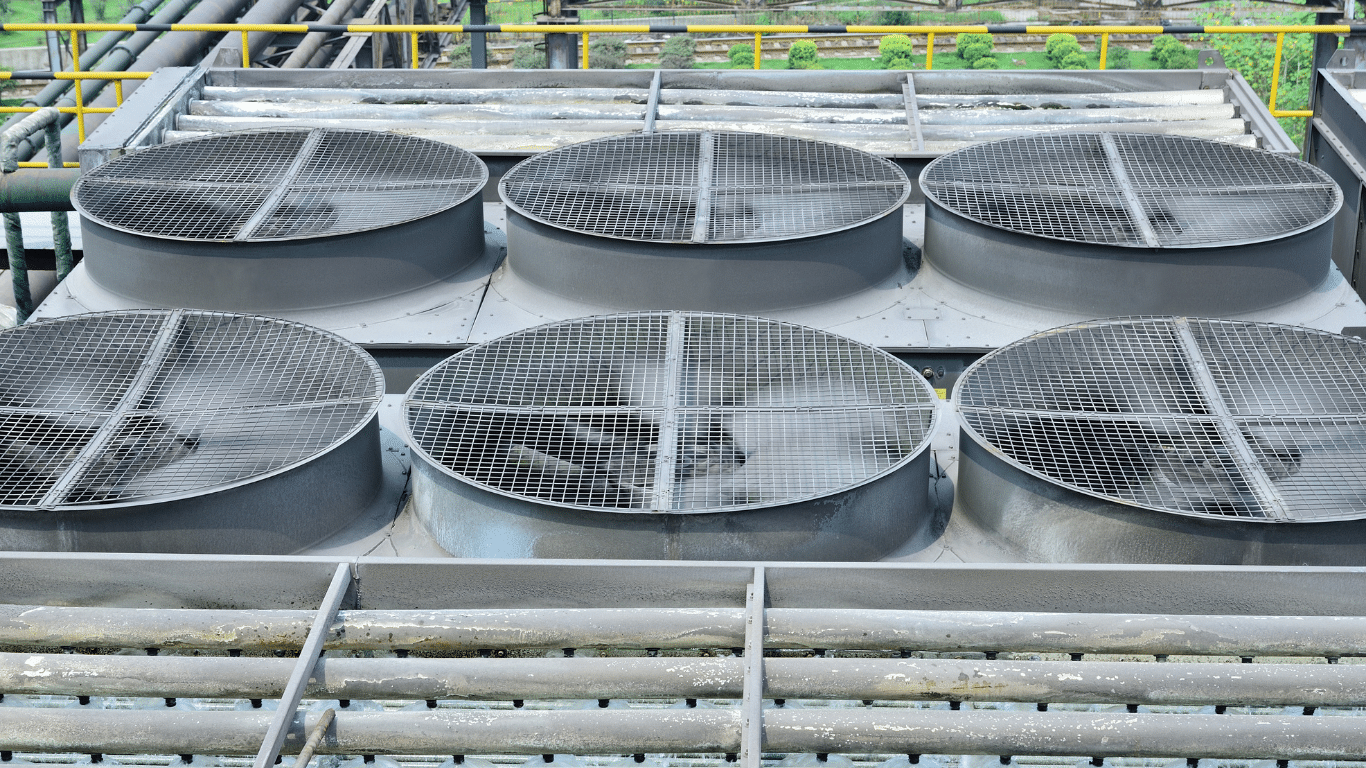
Cooling towers play an important role in many industrial and commercial cooling systems. They help remove excess heat from equipment and processes, allowing facilities to maintain stable operating conditions, improve efficiency, and protect valuable assets.
As you explore different cooling tower types, it is important to understand that no single design works for every application. Cooling towers vary based on operating requirements, available space, water conditions, and cooling demands. The right choice depends on how a facility uses water and manages heat within its overall system. Understanding these differences helps operators and facility managers make informed decisions that support long-term performance and efficiency.
Why Understanding Cooling Tower Types Matters
Choosing among different cooling tower types is about more than selecting equipment. The design of a cooling tower system directly affects how effectively a facility removes excess heat, manages operating costs, and maintains reliable performance. When the tower matches the application’s cooling requirements, operators often see better cooling efficiency, lower energy use, and fewer operational challenges over time.
We often remind facility teams that cooling demands vary from one operation to another. Industrial facilities may need to support demanding production processes, while HVAC systems focus on maintaining comfortable indoor environments. Because of these differences, the right tower design can improve reliability, help equipment operate within target temperatures, and support long-term system performance. Taking the time to understand cooling tower types helps organizations make decisions that align with both operational goals and efficiency objectives.
Cooling Towers Classified by Draft Method
One of the most common ways to categorize the types of cooling towers is by how they move air through the tower. This airflow, often called the draft, plays a major role in the cooling process. A draft cooling tower uses either natural airflow or mechanical equipment to move air across circulating water, allowing heat to leave the system through evaporation and contact with cooler air.
Natural draft cooling towers rely on natural convection rather than fans. As warm air inside the tower rises, cooler outside air enters from below and continues the cycle. These structures are often recognized by their tall, curved shape, which is why many people associate hyperbolic cooling towers with large industrial sites. Natural draft cooling is most common in power plants and other facilities that require continuous cooling on a very large scale.
Mechanical draft cooling towers use fans to control airflow through the tower. Because operators can regulate air movement, these systems offer greater flexibility and a more compact footprint than natural draft designs. Most industrial and commercial cooling applications use mechanical draft cooling towers because they can adapt to varying operating conditions while maintaining consistent performance. Understanding these two approaches provides a solid foundation for selecting the right cooling solution for a facility’s needs.
Forced Draft Cooling Towers
Forced draft cooling towers use a fan located at the air inlet to push force air into the system, creating controlled air movement through the tower. In this design, ambient air is actively driven across the fill media to enhance heat exchange efficiency. Because the fan is positioned at the intake, forced draft systems are generally more resistant to recirculation of warm discharge air, making them suitable for constrained industrial layouts. However, performance can be affected by external wind conditions, which may influence overall airflow distribution and cooling consistency.
Induced Draft Cooling Towers
Induced draft cooling towers use a fan at the discharge point to pull air through the system, drawing in warm air from the inlet and expelling exhaust air from the top. This induced draft design promotes more uniform airflow across the fill media, improving tower efficiency and thermal performance. By maintaining negative pressure inside the tower, it helps reduce air recirculation and supports more stable cooling operation. Induced draft systems are widely used in industrial and power generation applications due to their reliable heat rejection and consistent airflow control.
Cooling Towers Classified by Air and Water Flow
Cooling towers are commonly classified by how air to water flow is arranged, with the two main types being counterflow cooling towers and crossflow cooling towers. These configurations determine how air and water interact inside the system and directly affect heat transfer efficiency and operational design.
In counterflow cooling towers, air moves upward while water flows downward through the fill media, creating strong thermal contact as falling water is broken into fine droplets for improved heat exchange. This opposing movement typically delivers higher thermal efficiency and a more compact footprint, making counterflow systems ideal for demanding industrial applications. However, they may require higher fan power and can be more challenging to inspect due to their enclosed airflow design.
In crossflow cooling towers, air moves horizontally across the fill while water flows downward by gravity, allowing continuous interaction between air and water streams. This design generally offers easier maintenance access and lower pumping resistance, since distribution basins are more exposed. While crossflow systems are simpler to service, they may provide slightly lower thermal performance compared to counterflow designs under heavy heat loads, making selection dependent on efficiency needs, space, and maintenance priorities. If you’d like a deeper look at airflow and water movement inside a tower, see our guide on how cooling towers work.
Open Circuit vs Closed Circuit Cooling Towers
Cooling towers are classified into open circuit cooling towers and closed circuit cooling towers, based on whether the process fluid is exposed to air. This distinction directly affects heat transfer, system efficiency, and water quality control in industrial cooling applications.
In open circuit cooling towers, process water is directly exposed to air, where cooled water is achieved through evaporation and direct heat exchange. While this setup delivers efficient heat transfer, it also increases exposure to contaminants, scaling, and biological growth since water continuously interacts with ambient air. As a result, stronger water treatment and maintenance are required to sustain stable performance.
In closed circuit cooling towers, fluid circulates within closed circuit systems and does not directly contact air, improving cleanliness and system stability. Instead, heat exchangers transfer heat indirectly, enhancing control over heat transfer and protecting process water quality. This makes them ideal for sensitive operations. Facilities considering closed-circuit designs may also benefit from understanding how closed-loop water systems operate.
Key Components That Affect Cooling Tower Performance
Cooling tower efficiency depends heavily on several core parts that are common across most systems, including the cold water basin, tower fill, fill media, drift eliminators, and the water distribution system. Each component plays a specific role in supporting stable operation and optimizing heat transfer efficiency within the tower.
The water distribution system ensures even coverage of water over the fill media, while tower fill (including splash fill) increases contact surface area between air and water to enhance cooling performance. Proper fill condition is critical, as scaling or blockage can significantly reduce efficiency and disrupt airflow and water movement.
Meanwhile, the cold water basin collects cooled water for reuse, and drift eliminators minimize water loss by capturing entrained droplets before air exits the tower. Together, these components directly influence long-term performance and maintenance requirements. Understanding cooling tower components helps operators identify performance issues before they affect efficiency.
Choosing the Right Cooling Tower for Your Facility
Selecting the appropriate cooling tower design depends on key operating conditions such as heat load, cooling load, and integration with commercial HVAC systems. These factors determine the size, configuration, and capacity required to maintain stable system performance while meeting process cooling demands.
Environmental conditions also play a major role in selection, particularly ambient air temperature and wet bulb temperature, which directly influence cooling capability and overall system efficiency. In hotter or more humid climates, towers must be properly sized to maintain reliable heat rejection without overloading equipment or increasing energy consumption.
Long-term considerations such as energy efficiency, operating costs, and future expansion needs are also critical when evaluating cooling tower design. Choosing a properly matched system ensures lower lifecycle costs, improved reliability, and flexibility for facility growth while maintaining consistent performance under varying load conditions.
Supporting Long-Term Cooling Tower Performance
Maintaining optimal system performance in a cooling tower system requires consistent attention to water quality, mechanical condition, and operational balance. Over time, industrial processes can introduce variables that reduce cooling efficiency, making proactive management essential for stable operation and consistent energy efficiency.
Effective water treatment plays a critical role in preventing scaling, corrosion, and biological growth that can compromise heat transfer surfaces and reduce system reliability. Regular inspection and monitoring of key components also help identify early performance issues before they escalate into costly downtime or efficiency losses.
For facilities looking to improve long-term reliability, evaluating both operational practices and treatment strategies is essential to sustaining performance. ProChem supports industrial operators in optimizing cooling tower system performance through tailored water treatment and maintenance solutions that improve efficiency, reduce fouling risks, and extend equipment life. Contact us today to learn how ProChem can help optimize your cooling tower performance and improve long-term system efficiency.
Frequently Asked Questions (FAQ)
What are wet cooling towers and where are they commonly used?
Wet cooling towers, also known as evaporative cooling towers, use evaporative cooling to remove heat from water by exposing it directly to air. As a portion of the water evaporates, heat is released, lowering the overall water temperature.
These systems are commonly used in industrial facilities, HVAC systems, and power generation where high heat rejection efficiency is required.
How do dry cooling towers differ from wet cooling towers?
Dry cooling towers rely on an air-based heat transfer method using finned tubes or heat exchangers, meaning there is no direct contact between air and water. Unlike wet systems, they do not rely on evaporation, so water temperature is reduced without water loss.
This makes dry cooling suitable for water-scarce environments, although it is generally less efficient in hot climates.
Why are cooling towers common in power plants?
Cooling towers are widely used in power plants because they efficiently remove large amounts of heat energy generated during electricity production. Large cooling towers help condense steam back into water for reuse in the system, improving efficiency and enabling continuous operation of turbines.
How does relative humidity affect cooling tower performance?
Relative humidity directly impacts cooling performance by influencing the wet bulb temperature, which determines how effectively heat can be removed from water. When humidity is high, the ambient air is already moisture-saturated, reducing evaporation rates and lowering overall cooling tower efficiency.
What is a multi cell cooling tower and when is it beneficial?
A multi cell cooling tower consists of multiple interconnected cells that operate together to handle varying loads. These factory assembled cooling towers offer flexibility in managing variable water flow, allowing sections to be shut down or operated as needed.
This design is beneficial for large industrial facilities requiring scalable capacity and redundancy for maintenance or fluctuating demand.
