
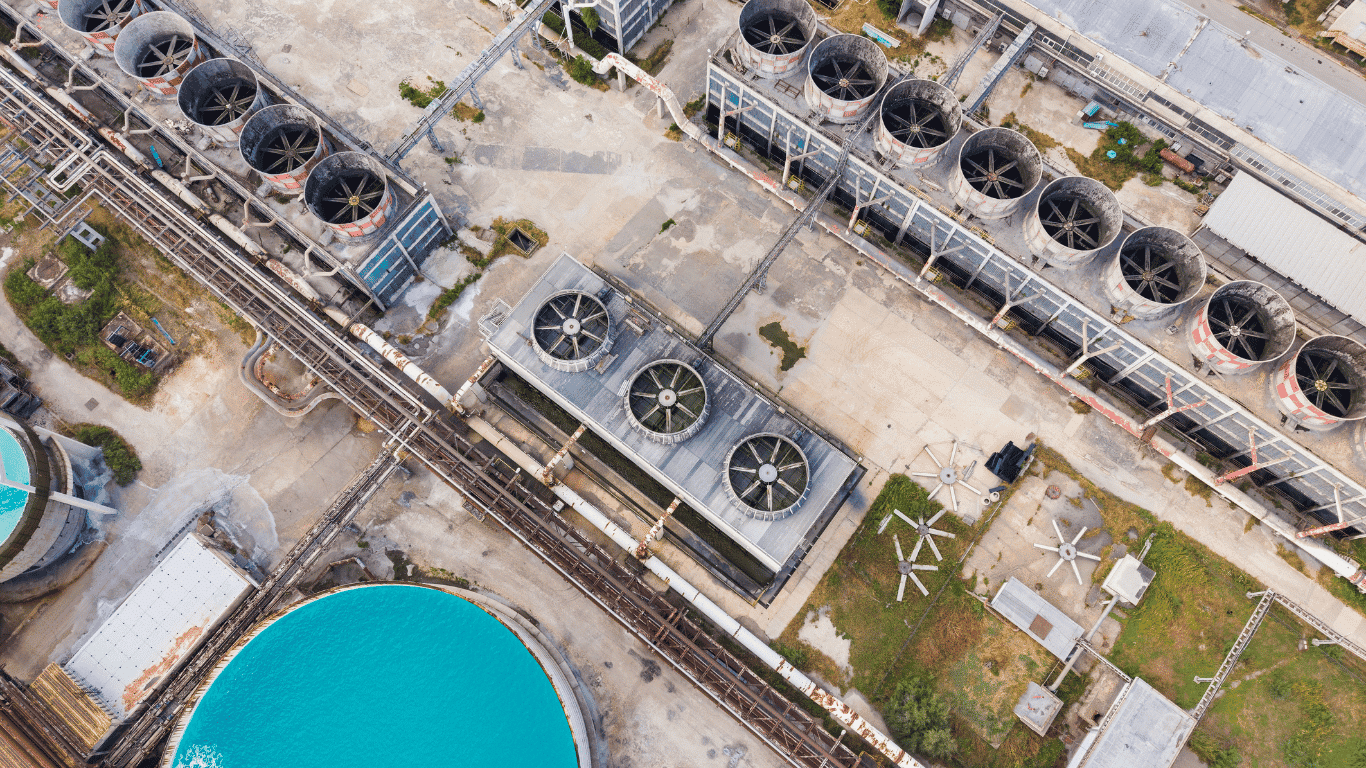
When equipment runs continuously, heat has to go somewhere. A cooling water system gives industrial facilities a controlled way to move unwanted heat away from equipment and process streams. This helps keep operations stable when industrial processes generate heat faster than equipment can safely dissipate it.
Cooling systems support reliable operation across power plants, manufacturing facilities, and HVAC infrastructure. Still, effective cooling involves more than circulating cooling water. Teams need to consider how system design, operating conditions, water quality, and heat rejection work together. Choosing the right approach helps water systems handle their heat load reliably while supporting consistent equipment performance.
How Cooling Water Systems Work
A cooling water system acts as both a heat-transport and heat-rejection system. Pumps provide the pressure and water flow needed to move the circulating coolant through process equipment. As the water passes through a heat exchanger, it picks up waste heat from the process fluid. The cooling water then carries that heat toward a point where the system can safely release it.
The amount of heat load directly affects how much circulation and heat transfer the system needs. A higher heat load can require greater water flow and sufficient heat-transfer capacity to keep equipment within its operating range. In many industrial applications, cooling water serves as a heat transfer medium because it can absorb heat efficiently and move it away from critical equipment. Teams should also consider system configuration when evaluating industrial water cooling systems.
The final heat-rejection step depends on the equipment and application. A cooling tower, air cooling equipment, or another heat-rejection device can remove heat from the water before it returns to the process. Operators should watch for changes in water flow, supply and return temperatures, pump performance, and heat exchanger performance. Gradual changes often provide an early warning of fouling, restrictions, or declining system performance.
Main Types of Cooling Water Systems
Industrial cooling systems generally use one of three configurations: once through cooling, open recirculating, or closed recirculating. A once through cooling system draws fresh cooling water from a source, sends it through equipment or a heat exchanger, then discharges the warmed water. Large once through systems can use millions of gallons daily, particularly in power generation, and more than 1,200 U.S. power plants use this approach. Because these open loop systems discharge water after use, operators must consider water availability, water consumption, thermal pollution, and environmental compliance when selecting a system.
Open recirculating cooling systems reuse water repeatedly, while cooling towers remove heat through evaporation. Water leaves the recirculating system through evaporation and blowdown, so makeup water replaces those losses. This configuration remains common in industrial applications because it can reduce water consumption compared with many once through systems. However, evaporation concentrates dissolved minerals in the circulating coolant, so open recirculating systems need consistent water treatment and monitoring. In contrast, closed recirculating systems keep water within a closed loop, with little to no evaporation. These closed loop systems typically need much less makeup water, often around 5–15% annually depending on application and system losses, while reducing water consumption and contamination exposure. Even a closed system still needs water treatment and monitoring to protect equipment and maintain reliable circulation.
Selecting the right cooling water system requires more than comparing water use. Teams should consider the facility’s heat load, water availability and cost, environmental requirements, equipment design, desired operating temperature, and maintenance requirements. These factors help determine whether once through cooling, an open recirculating system, or a closed loop approach makes the most practical choice for the facility.
How Cooling Towers Reject Heat
Cooling towers provide a common method of heat rejection in open recirculating systems. Warm water enters the tower and spreads across the cooling tower fill, or tower fill, which increases contact between the water and moving air. As ambient air moves through the tower, a portion of the water evaporates. This evaporative cooling process removes heat from the remaining water and sends cooler water back into the system. Depending on the design and operating conditions, cooling towers can achieve temperature changes of approximately 10–30°F.
The effectiveness of this process depends on several operating conditions. Ambient air temperature and ambient temperature influence how readily the tower can reject heat, while airflow and water distribution affect mass transfer between the two. Mechanical-draft and natural-draft tower systems use different methods to move air, but both depend on good water and air contact. At higher temperatures, operators may need to pay closer attention to tower performance because the available temperature difference can change.
Water quality also plays a direct role in cooling tower efficiency. Mineral deposits, suspended solids, and biological growth can foul the tower fill, restrict airflow, and reduce water-air contact. Operators should monitor tower operation, water distribution, airflow, and cleanliness as part of routine checks. It also helps to track evaporation, blowdown, and concentration levels. Our guide to cooling tower cycles of concentration provides additional guidance on managing water concentration as tower systems operate.
Managing Water Quality in Cooling Systems
Water quality directly affects cooling system reliability, heat transfer, equipment life, and operating costs. Poor water chemistry can cause scale formation, corrosion, and fouling, while suspended solids can settle where flow is poor. Deposits can reduce heat transfer and increase energy requirements, while corrosion can damage carbon steel, the pipe wall, heat exchangers, and other metal surface areas, and deposits may induce under deposit corrosion. Poor microbiological control can also allow biological growth, slime, and biofilm to restrict flow and reduce heat transfer.
A targeted water treatment and chemical treatment strategy helps minimize corrosion and control microbial activity. Chemical treatment programs may use anti-scalants, corrosion inhibitors, and biocides, with treatment based on pH, hardness, dissolved solids, and actual operating conditions. Even closed loop water needs monitoring because a closed system can still develop corrosion, fouling, or biological issues. In open recirculating water systems, blowdown removes concentrated water while makeup water replaces evaporated and discharged water. Cooling towers often operate around 4–6 cycles of concentration, although the appropriate target depends on system design and water chemistry. For more guidance, see our cooling tower water treatment resource.
Operators should establish water-quality targets and monitor them consistently rather than relying on generic chemical dosages. Teams should connect chemistry results with actual system conditions, including flow, heat transfer, and equipment performance, then adjust treatment as conditions change. This practical approach helps control scale, corrosion, fouling, and biological growth while protecting water systems, equipment, and operating costs.
Maintaining Cooling System Performance
Regular inspections help teams catch scaling, fouling, corrosion, biological growth, leaks, and flow restrictions before they affect system performance. Start with water flow and pump performance, then compare supply and return temperatures while watching changes in approach temperature, pressure drop, and flow characteristics. These trends can reveal developing restrictions and reduced efficiency. Inspect heat exchangers and heat transfer surfaces for deposits, and check cooling tower components, tower fill, and water distribution as part of routine water systems maintenance.
Teams should connect water chemistry with equipment performance rather than reviewing each separately. Fouled heat-transfer surfaces can reduce heat transfer, increase power consumption, and limit energy efficiency. Keeping surfaces clean supports efficient heat transfer and more energy efficient operation. Operators should monitor water chemistry, scale, fouling, corrosion, and biological growth alongside pumps, heat exchangers, cooling towers, and other system components. They should also verify blowdown and makeup water operation and document changes over time instead of relying only on visual inspections.
A consistent maintenance routine helps address problems before they become costly failures. Operators should review temperature trends, water flow, pump pressure, tower operation, and water chemistry regularly, while checking for scale, fouling, corrosion, biological growth, and other signs of trouble. This proactive approach can reduce maintenance costs and protect process streams and connected equipment. It also helps maintain reliable system performance, support energy efficiency, and keep the cooling system operating within its intended heat-transfer range.
Building a Reliable Cooling Water Strategy
Start with the facility’s heat load and cooling requirements, then select the right cooling water system based on water availability, cost, discharge requirements, and equipment needs. From there, establish clear water quality targets and monitor flow, temperature, pressure, and chemistry. An effective water treatment program should control scale, corrosion, and biological growth, while regular attention to cooling towers, heat exchangers, pumps, and other system components helps protect equipment and maintain reliable cooling systems.
The best results come from treating cooling as an ongoing operating strategy, not a one-time setup. Track operating trends so teams can catch performance changes early, review water consumption, and look for practical opportunities to improve energy efficiency across industrial facilities. If changing temperatures, inconsistent flow, recurring scale, or rising water use are becoming concerns, ProChem can help your team evaluate the conditions affecting industrial processes and process equipment and develop a practical approach to keep your cooling operation reliable.
Frequently Asked Questions (FAQ)
What are the main types of cooling water systems?
The three main configurations are once through cooling systems, open recirculating systems, and closed recirculating systems. Once through systems use fresh water once before discharge, while open recirculating systems reuse water and rely on evaporation and makeup water. Closed recirculating systems keep water within a closed loop with little evaporation, generally reducing water consumption and treatment demands.
How much water do cooling systems use?
Large cooling systems can use millions of gallons daily, particularly when facilities rely on once through cooling and withdraw fresh cooling water for a single pass. Open recirculating systems reduce water demand through repeated circulation, although evaporation and blowdown still require makeup water. Water availability, cost, and discharge requirements all influence the most practical approach.
What causes cooling water systems to lose efficiency?
Scale formation, fouling, corrosion, poor water chemistry, suspended solids, poor flow, biological growth, and higher temperatures can all reduce heat transfer. Deposits can accumulate on heat transfer surfaces, restricting flow and insulating surfaces. Monitoring system performance and water quality helps operators identify conditions that reduce heat transfer before they cause larger problems.
Do closed loop cooling systems need water treatment?
Yes. Even a closed loop can experience corrosion, biological growth, and chemistry changes. Closed loop water has little evaporation, but that does not eliminate treatment needs. Appropriate chemical treatment helps protect metal surfaces, carbon steel, and other system components. Some applications also require freeze protection to protect a closed system during low-temperature conditions.
How do cooling towers improve heat rejection?
Cooling towers distribute warm water across tower fill while ambient air moves through the tower. Evaporative cooling removes heat as a portion of the water evaporates, creating mass transfer between water and air. Mechanical-draft and natural-draft towers use different airflow methods. Other applications may use air cooling or an air cooled condenser for heat rejection when a cooling tower does not fit the process requirements.
