
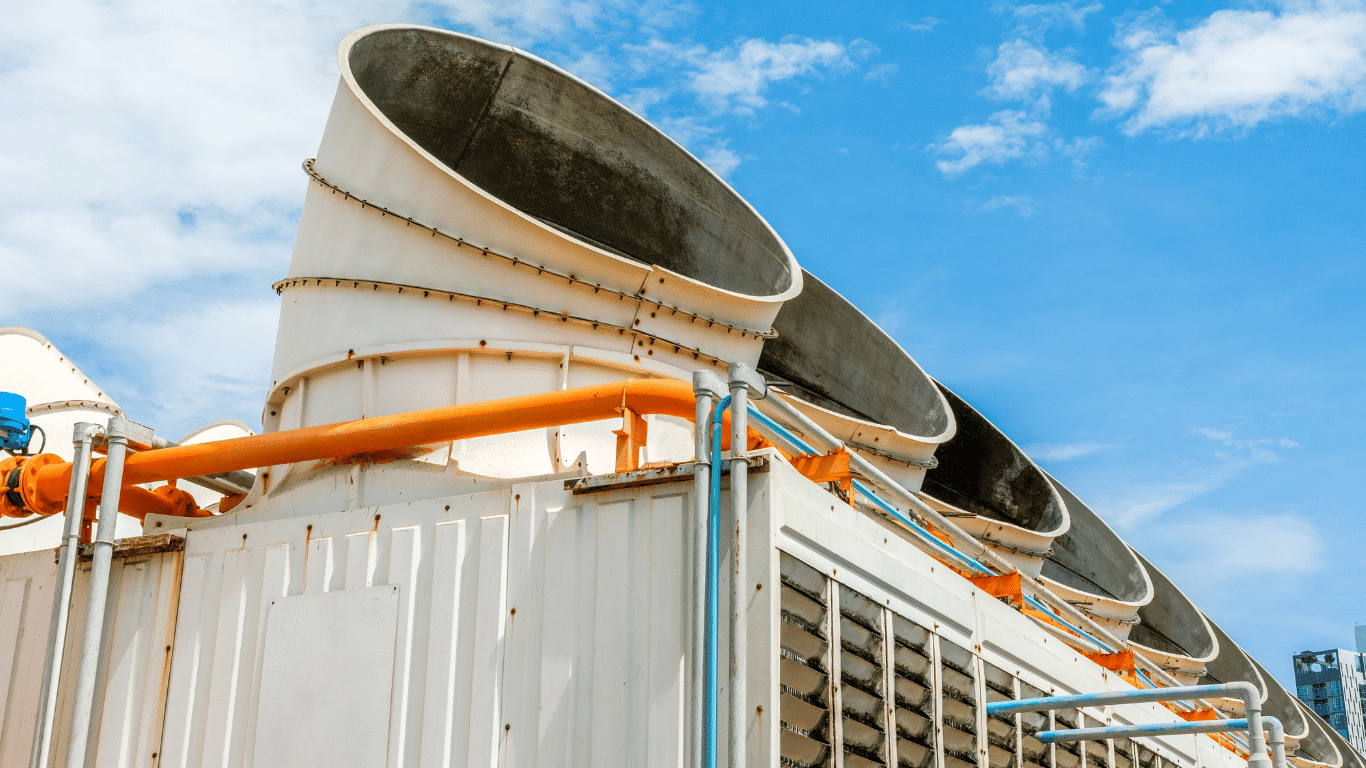
A cooling tower continuously loses water as heat leaves the system through evaporation. The facility replaces that loss with makeup water, but the dissolved minerals and other materials in the water do not evaporate with it. As a result, the concentration of these materials gradually increases in the circulating water.
That is where cycles of concentration become useful. This measurement gives operators a practical way to understand how concentrated their cooling tower water has become compared with the incoming makeup water. Keeping that relationship in the right range helps you balance water efficiency with reliable tower operation.
What Cycles of Concentration Tell You About Tower Water
Think of a cooling tower system as a continuous balance between water entering, water leaving, and water circulating through the equipment. Evaporation removes water from the system, while makeup water replaces it. Dissolved solids remain behind, so the recirculating water becomes progressively more concentrated.
For example, a tower operating at four cycles has a concentration of dissolved materials approximately four times that of its makeup water. Most cooling towers operate somewhere around two to four cycles, although the appropriate target depends on makeup water quality, system design, treatment chemistry, and operating conditions. The goal is not simply to reach the highest possible number.
This balance matters because dissolved minerals can eventually reach their solubility limits. When that happens, the cooling tower may experience scale deposits, corrosion, or other water chemistry problems. Understanding cycles gives operators a useful starting point for deciding when to control concentration and when to adjust their water treatment approach.
How to Calculate Cycles of Concentration
One of the simplest ways to calculate cycles of concentration uses conductivity. Operators compare the conductivity of the system water with the conductivity of the incoming makeup water.
COC = System Water Conductivity ÷ Makeup Water Conductivity
For example, if your system water has a conductivity of 1,200 µS/cm and your makeup water measures 300 µS/cm, the calculation gives four cycles. In practical terms, the dissolved material concentration in the tower water is approximately four times the concentration found in the makeup water. Conductivity does not measure every individual contaminant, but it provides a convenient indicator for tracking overall dissolved material concentration.
Operators can also use chloride or silica measurements to calculate or verify concentration. The best measurement depends on the system and its water chemistry. If your makeup water quality changes, your conductivity relationship can change as well, so avoid treating one conductivity reading as a permanent target. Regular monitoring gives you a much clearer picture of what is happening inside the tower.
Why Blowdown Matters at Higher Cycles
As concentration increases, the cooling tower needs a controlled way to remove some of that concentrated water. This process, known as cooling tower blowdown, removes a portion of the recirculating water and allows fresh makeup water to enter the system. That exchange helps keep dissolved solids within an acceptable operating range.
The blowdown rate and frequency should support the target cycles established for the system. A blowdown valve can help automate this process by responding to conductivity or another selected control point. When the system reaches the desired concentration, the control sequence can release water and bring in makeup water to restore the chemistry.
The key is balance. Too little blowdown allows dissolved solids to continue building up, which increases the risk of scale and other chemistry problems. Too much blowdown sends usable water and treatment chemicals down the drain unnecessarily. Effective blowdown keeps the tower within its operating range while supporting better water efficiency.
What Happens When Cycles Get Too High?
Higher cycles can reduce the amount of makeup water a cooling tower needs, but that benefit comes with a tradeoff. As water evaporates, dissolved minerals become increasingly concentrated. If the concentration rises beyond what the treatment program and system chemistry can manage, the risk of scale formation increases.
Calcium carbonate and calcium sulfate can contribute to scale deposits on heat transfer surfaces. Even a relatively thin deposit can interfere with heat transfer and force equipment to work harder to achieve the same cooling result. In some operating conditions, deposits can reduce heat transfer efficiency by roughly 10 to 15 percent, although the actual effect varies with deposit thickness, equipment design, and operating conditions.
Excessive concentration can also contribute to higher corrosion rates and biological activity when the water treatment program does not adequately control the system chemistry. That is why higher cycles should never become a target simply for the sake of reducing makeup water. You need to keep the entire cooling system within a range that supports reliable system performance.
Finding the Right Target Cycles for Your System
The right target cycles depend on the water entering the tower and the conditions inside the system. Start with your makeup water quality, then look at conductivity, hardness, dissolved minerals, alkalinity, treatment chemistry, equipment materials, and operating temperatures. These factors help determine how far you can concentrate the tower water before scaling or corrosion becomes difficult to control.
It can be tempting to keep increasing cycles because higher cycles generally reduce makeup water requirements. However, the highest possible concentration is not necessarily the most efficient operating point. A target that looks good on paper can create additional cleaning, chemical, maintenance, or equipment costs if the system chemistry becomes difficult to manage.
A properly designed cooling tower water treatment program helps you find that balance. The objective is to maintain the right target cycles while controlling scale, corrosion, and biological activity. When the treatment program matches the actual water chemistry, you can pursue water savings without putting system performance at unnecessary risk.
Monitoring and Managing Cycles for Better Efficiency
Once you establish a target, simple monitoring becomes one of the most useful tools you have. Track makeup water conductivity and system water conductivity, check the blowdown rate, and watch for changes in water consumption. If the numbers begin moving outside the expected range, investigate the cause rather than simply adjusting the set point.
It also helps to monitor total dissolved solids and other relevant water chemistry indicators. A sudden increase can point to inadequate blowdown, a change in makeup water quality, or another operating issue. Reviewing these measurements alongside treatment chemical usage gives you a more complete picture of how the tower is performing.
Consistent monitoring can also help you identify opportunities to improve thermal efficiency and reduce unnecessary energy consumption. When the system maintains appropriate water chemistry, heat transfer surfaces stay cleaner and the cooling equipment can operate closer to its intended performance. The goal is not just to use less water. It is to use water intelligently while protecting the system.
Key Takeaways for Managing Tower Cycles
Managing cycles starts with a clear understanding of your makeup water quality and the chemistry of the recirculating water. Measure conductivity consistently, establish realistic target cycles, monitor blowdown, and watch for changes in scale, corrosion, biological activity, and water consumption. If you want to take the next step, cooling tower blowdown management can help you control dissolved solids while avoiding unnecessary water and chemical waste. When you bring these practices together, you have a much better foundation for improving water efficiency without sacrificing system performance.
Building a More Efficient Cooling Tower Water Strategy
Good cycle management rarely depends on one adjustment. Operators should look at the complete water management picture, including makeup water quality, conductivity monitoring, blowdown control, filtration, and chemical treatment. Each part affects the others, so an isolated change can sometimes create another problem elsewhere in the system.
For example, increasing the target cycles without reviewing scale control may increase mineral buildup. Likewise, increasing blowdown without reviewing the reason for high conductivity may waste water without addressing the underlying issue. A coordinated approach gives you better control over water efficiency, chemical consumption, and operating costs.
Need help reviewing your cooling tower water strategy? ProChem Inc. can help you evaluate the water chemistry, treatment approach, and operating practices that support efficient and reliable tower performance.
